Good morning class! Settle down, take your seats.
Today I”d like to introduce a very special guest professor. Our friends from Stillmotion will be taking the reins for the next few weeks, using their experience as Emmy award-winning filmmakers to teach you a very special skill — the art of storytelling.
As filmmakers, storytelling is at the core of what we do. Whether you”re making a narrative, a documentary, or a commercial, short or long form, you are telling a story to your audience.
As a storyteller you have the opportunity to connect with your audience on a very deep level, to make people feel, think, and act — but only if you do it right! Storytelling may seem simple, and in a way it is. Some very basic principles are at the basis of it all. It”s remembering these principles and making every decision, from pre- to post-production, based on them, that is the key to great storytelling.
Without further ado, I”ll hand it over to Patrick and his team, who are going to walk you through what they have learned about storytelling from seven years of hands on experience in the business:
OK, let”s recap!
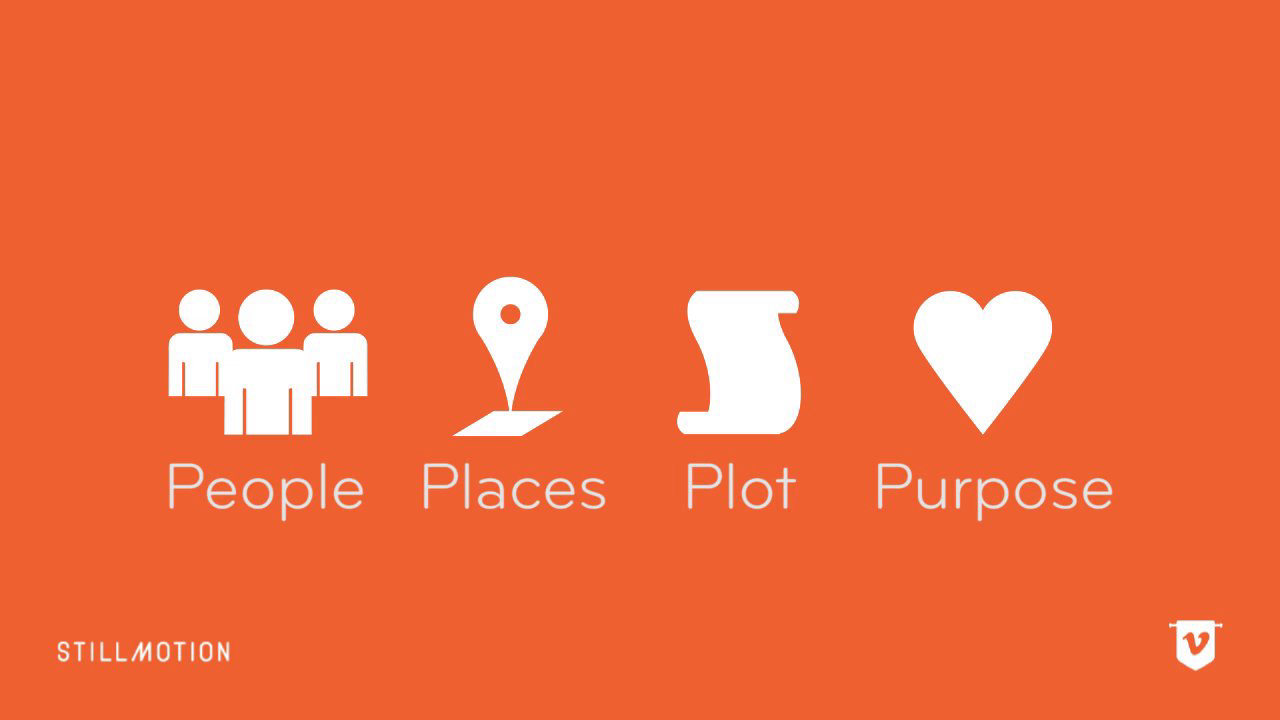
As Patrick said, before his team takes on a project, they make sure they have a firm understanding of what they call the Four P”s: People, Place, Plot, and Purpose.
1. People: Who is in the story?
Characters are what make us emotionally invested in a story. You”ll want your audience to root for your protagonists and against your antagonists. Also, keep in mind:
- Your character could be an object and not just a person: For example, in this wedding video, the couple”s 1970s Winnebago is portrayed as a strong third character.
- Sometimes your characters are not the obvious ones: such as in this profile on pro golfer Phil Mickelson where his caddy of 18 years, Bones, is presented as a key character.
2. Place: Where does the story take place?
Location can add depth and intrigue to your characters and story, and can visually communicate a great amount of information in a short period of time. When choosing a location, Stillmotion keeps the following in mind:
- Relevance: Does it relate to your character or overall story?
- Comfort: Will the characters feel at ease and act naturally?
- Production friendly: Is the space, lighting, and noise level conducive to a good shoot?
For example, in their film I”m Fine Thanks, the team documented a woman in her 150 square-foot tiny home. While they faced physical challenges shooting in such tight quarters, they preferred this to shooting outside with uncontrollable light and audio. Plus, the loft was extremely relevant to the story and message of the interview.
As with characters, Stillmotion encourages us to think creatively with location as well, and to go beyond the first or most obvious location presented to you.
3. Plot: What is the conflict and the journey?
Stillmotion believes that every piece, even a commercial, needs a conflict to drive the narrative. That doesn”t mean every story needs a villain. Conflict and tension can come in many varieties.
For example, in Stu & Dana”s wedding film, they used the tension of Stu”s struggle to memorize his wedding vows to draw the viewer in to empathize with and root for their character.
As Patrick explains, conflict is important because it allows the audience to ask questions. Once your viewers have no unanswered questions, they”ll lose interest.
4. Purpose: Why should anyone care about this?
The Stillmotion mantra here is “know what you need to say before you speak.” Throughout the production process it”s important to always be going back to this essential purpose, reminding yourself why you”re telling this story and why others will care about it.
For example, in I”m Fine Thanks, the team”s purpose was to make a film that challenged people to reclaim their dreams. They explored stories of people who had confronted complacency in their own lives, always with this central purpose in mind.
Even if you are working on a commercial piece for a client, it”s still important to approach the piece the same way, with a clear purpose. If you approach it with the same passion that you have for personal projects, you”ll end up with a stronger piece, which is exactly what happened with PULSE, the piece Stillmotion did for a company called BioBeats.
Congratulations!
You made it through part one. Remember, we've still got three more parts to go. The closer you pay attention and follow along now, the more prepared you'll be for the storytelling contest we'll be launching at the end of this online workshop!
So if you're competitive and like winning prizes (that's right I said prizes), or you're just looking to brush up on your skills, I suggest you stick around! Next up, we'll explore Stillmotion's process of researching keywords to guide the rest of your production.
Vimeo empowers creators with tools for producing, sharing, and managing their projects. Features include screen capture software software, a teleprompter tool, and detailed analytics.